

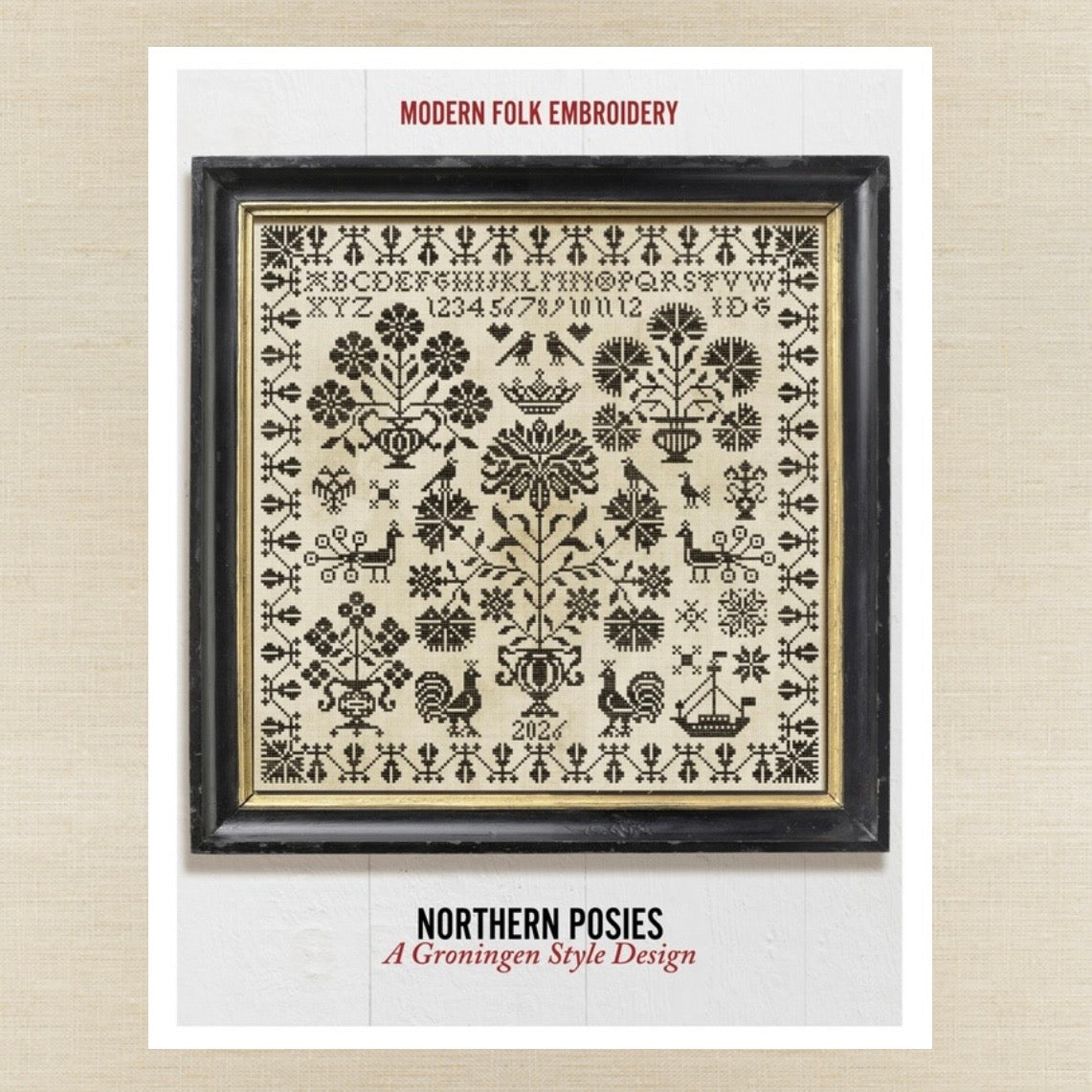
Modern Folk Embroidery - Northern Posies: A Groningen Style Design - Booklet Chart IH
Modern Folk Embroidery - Northern Posies: A Groningen Style Design - Booklet Chart IH
Couldn't load pickup availability
A physical booklet chart for Modern Folk Embroidery's design "Northern Posies". Please see the chart description below for more details.
This chart measures 195 crosses wide and 195 crosses tall for a total of 12, 452 crosses
When stitching this chart 1 over 2, you will need 4 skeins of floss
When stitching this chart 2 over 2, you will need 7 skeins of floss
You can stitch this chart in any colour that you choose.
Looking for floss and fabric suggestions? We think this design would look great stitched with Roxy Floss Co Charcoal on Roxy Floss Co Arrowroot or Roxy Floss Co Porcelain
If stitching on 28ct linen, you will need a half yard to stitch this chart. If stitching on 32ct linen or higher, you will need a wide quarter to stitch this chart.
From the Designer:
Northern Posies is a sampler inspired by the black samplers of the province of Groningen. Bordering Friesland to the west, Groningen produced stunning colourful samplers that look very similar to those worked in Friesland. At some point in the late 18th century, we see a shift from colourful to striking black samplers, with a distinct visual language.
Whereas Friesland samplers are known for their rather chaotic structures, those from Groningen were often worked in near-perfect symmetry. If motifs weren’t mirrored exactly, stitchers would select motifs that could be worked so that a very balanced image resulted. The reason why the Groningen girls stitched with black floss is unknown. It certainly wasn’t because of poverty, since most girls came from very wealthy farming families. It didn’t have anything to do with being in mourning either.
Personally, I think it might be a move toward more sober stitching driven by religious convictions. The province had a high number of strict reformed Christian communities, to which many of the farmers’ daughters who produced these stunning samplers belonged. We see a similar move in the late 18th century with the Religious Society of Friends (better known as Quakers) in England. Quaker girls produced both extremely colourful and black/dark samplers, of which the earliest dated work is very colourful. In the Vierlande region of Northern Germany (close to the town of Hamburg), girls produced colourful samplers at the same time, but also chose to stitch their samplers in black (sometimes adding an accent colour).
- Applicable sales tax or VAT will be calculated at check out.
Subscribe to our emails
Subscribe to our mailing list for insider news, product launches, and more.